Taoism in Tarot: Flow, Balance, and Symbolic Wisdom

Updated: Mar 26
Across different cultures and time periods, people have developed systems to understand life’s patterns and uncertainties. Taoism and Tarot come from very different historical contexts, yet they share an interesting philosophical overlap: both encourage reflection on the natural rhythms of life rather than strict control over outcomes.
This article explores the relationship between Taoism and tarot, explaining how Taoist ideas such as the Tao, wu wei, and yin yang can provide a thoughtful philosophical framework for interpreting tarot symbolism. The goal is not to present tarot as a scientifically predictive tool, but as a symbolic method for reflection, insight, and awareness of life’s patterns.

What Is Taoism?
Taoism (also spelled Daoism) is a philosophical and spiritual tradition that originated in ancient China around the 4th–3rd centuries BCE. It is most commonly associated with the classic text Tao Te Ching, traditionally attributed to the philosopher Laozi. At the center of Taoist thought is the concept of the Tao, which literally means “the Way.”
The Tao refers to:
The underlying process through which the universe unfolds
The natural order of reality
The dynamic flow connecting all things
Rather than describing a creator deity or rigid rules for life, Taoism focuses on observing and aligning with the natural patterns of existence.
A simple metaphor
Imagine a river flowing through a landscape.
The river moves naturally around rocks and obstacles.
It does not resist the terrain.
Over time, it shapes the landscape simply by following its course.
In Taoist philosophy, human life works best when it behaves like this river: adapting, flowing, and responding to circumstances rather than constantly forcing outcomes.
Key Taoist Concepts
Several foundational ideas help explain how Taoist philosophy views the world.
The Tao: The Natural Order of Reality
The Tao represents the fundamental process behind the universe. Important aspects of the Tao include:
It cannot be fully described in words.
It exists in everything.
It expresses itself through natural patterns and cycles.
In the Tao Te Ching, the Tao is described as the source from which all things arise and to which they eventually return.
Practical example
Consider the changing seasons:
Winter becomes spring.
Spring becomes summer.
Summer becomes autumn.
This repeating cycle reflects the natural rhythm of the Tao.
Wu Wei: Effortless Action
Another core Taoist principle is Wu Wei, often translated as “non-forcing” or “effortless action.” Wu wei does not mean doing nothing. Instead, it means acting in harmony with circumstances rather than struggling against them.
Everyday examples
Wu wei can appear in simple situations:
A skilled musician improvising naturally rather than overthinking each note.
An athlete reacting instinctively during a game.
Someone choosing patience instead of forcing a situation that is not ready to unfold.
In Taoist philosophy, effective action often comes from alignment with the moment rather than excessive control.
Yin and Yang: Balance of Opposites
One of the most recognizable Taoist ideas is Yin and Yang.
Yin and yang represent complementary forces that exist together in balance. Examples include:
Yin | Yang |
Night | Day |
Rest | Activity |
Cold | Heat |
Receptivity | Action |
Rather than opposing each other, these forces depend on each other to create balance.
A practical metaphor
Think of breathing:
Inhale (yin)
Exhale (yang)
Both are necessary. Life continues through their alternating rhythm.
Simplicity and Harmony with Nature
Taoist philosophy also emphasizes values such as:
Simplicity
Humility
Alignment with nature
Flexibility and adaptability
The ideal life in Taoism is not one of constant achievement or domination, but one of balance and awareness of natural rhythms.
Philosophical Taoism vs Religious Taoism
Over time, Taoism developed into both a philosophy and a religious tradition.
Philosophical Taoism
Early Taoist philosophy focuses on texts such as:
Tao Te Ching
Zhuangzi (associated with the philosopher Zhuang Zhou)
This tradition emphasizes:
Understanding the Tao
Living simply
Aligning with natural patterns
Religious Taoism
Later forms of Taoism developed:
Temples
Ritual practices
Spiritual cultivation techniques
Deities and immortals
Both forms remain part of Taoist culture today, though philosophical Taoism is often what people refer to when discussing Taoist ideas in modern philosophy or psychology.
How Taoist Ideas Relate to Tarot Readings
At first glance, Tarot and Taoism may seem unrelated. Tarot originated in Europe centuries after Taoist philosophy developed in China. However, many readers interpret tarot through a philosophical lens that resembles Taoist thinking.
Tarot as reflection, not prediction
From a psychological perspective, tarot cards function as symbolic prompts rather than scientifically verified predictive tools.
A tarot reading can help someone:
Reflect on current circumstances
Notice behavioral patterns
Consider possible outcomes
explore personal perspectives
In this sense, tarot becomes a mirror for reflection, similar to how Taoism encourages observation of life’s natural patterns.
Wu Wei and Tarot Interpretation
The Taoist principle of wu wei can influence how tarot readings are approached.
Instead of treating tarot as something that determines fate, a Taoist-inspired approach focuses on:
Observing the situation
Understanding natural timing
recognizing when action is appropriate
recognizing when patience is wiser
For example, a tarot card suggesting pause or reflection may align with the idea of not forcing events before they are ready to unfold.
Tarot Cards That Reflect Taoist Principles
Several tarot cards symbolically express ideas similar to Taoist philosophy.
Wheel of Fortune – Cycles and Change
The Wheel of Fortune tarot meaning often revolves around cycles, change, and movement.
Symbolism commonly includes:
A turning wheel representing shifting circumstances
Figures rising and falling around the wheel
Symbols suggesting cosmic order
Taoist connection
The card reflects the Taoist understanding that:
Life constantly changes
Events move in cycles
No state lasts forever
Like the Tao, the wheel represents the ongoing flow of reality.
Temperance – Balance and Harmony
The Temperance tarot meaning centers on balance, integration, and moderation. Common imagery includes:
An angel blending water between two cups
A calm landscape suggesting equilibrium
A pathway leading toward distant light
Taoist connection
Temperance mirrors the Taoist idea of yin and yang balance. It suggests:
blending opposites
finding equilibrium
maintaining harmony between forces
The Star – Trust in the Natural Order
The Star tarot meaning is often associated with:
hope
renewal
trust in a larger pattern
The card typically shows a figure pouring water into both land and water beneath a bright star.
Taoist connection
The Star reflects faith in the unfolding of the Tao.
It symbolizes the idea that:
the universe has an underlying order
healing can emerge naturally over time
patience and openness allow renewal.
The Hanged Man – Surrender and Perspective
The Hanged Man tarot meaning often involves:
surrender
pause
a shift in perspective
The figure hangs upside down, appearing calm rather than distressed.
Taoist connection
This card closely resembles the Taoist principle of wu wei. Instead of forcing change, it suggests:
stepping back
allowing insight to emerge
seeing the situation from a new perspective
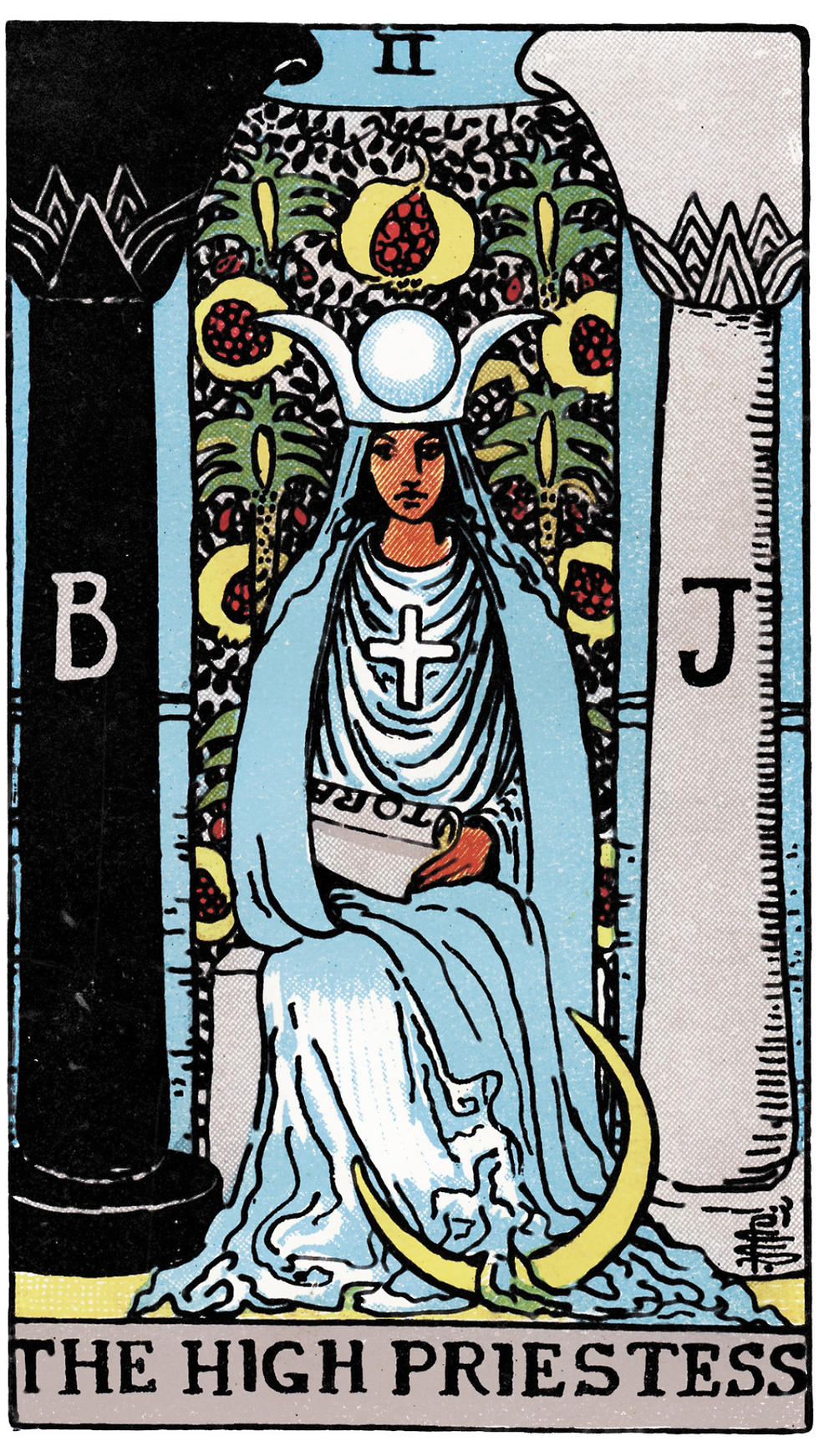
The High Priestess – Hidden Wisdom
The High Priestess tarot meaning often relates to:
intuition
hidden knowledge
quiet observation
She sits between pillars representing duality and balance.
Taoist connection
The High Priestess reflects the Taoist belief that reality has subtle layers beneath the surface. Like the Tao, this deeper order is often felt intuitively rather than explained logically.
Psychological Perspective on Tarot
Modern psychology offers useful insight into why tarot can feel meaningful.
Researchers studying symbolic systems and reflection note that tools like tarot can encourage:
self-awareness
introspection
narrative thinking
emotional processing
When people interpret symbols, they often project personal experiences and concerns onto them. This process can make abstract ideas easier to explore and articulate.
From a scientific standpoint:
There is no empirical evidence that tarot predicts the future.
Its value lies in reflection, storytelling, and perspective-building.
In this sense, tarot works similarly to other reflective practices such as journaling, meditation, or discussing life experiences through metaphor.
Conclusion
Although Taoism and tarot emerged in very different cultures, they share a common philosophical theme: life unfolds through patterns, cycles, and shifting circumstances.
Taoist philosophy encourages people to:
observe the natural flow of events
maintain balance
avoid forcing outcomes
Similarly, tarot symbolism can invite reflection on patterns, possibilities, and personal perspectives.
When approached thoughtfully, tarot does not need to be viewed as a tool that predicts the future. Instead, it can serve as a symbolic language for exploring the rhythms of life, much like Taoism encourages us to observe the quiet movement of the Tao itself.
By combining tarot philosophy with Taoist ideas such as wu wei and yin yang, readers may find a framework that emphasizes awareness, balance, and alignment with life’s unfolding path.
Join the Tarot Circle Workshop
If you feel curious about tarot or want to explore it in a deeper and more meaningful way, you are welcome to join The Tarot Circle Workshop.
The Tarot Circle is a relaxed and supportive space where we explore tarot beyond surface-level interpretations. Instead of simply memorizing meanings, we focus on learning how to read the cards with clarity, intuition, and understanding.
During the workshop, we explore:
How to interpret tarot with confidence
The symbolism and visual language within the cards
Practical reading techniques
How tarot can support reflection, insight, and self-awareness
The Tarot Circle is open to both beginners and experienced readers who want to deepen their relationship with tarot in a thoughtful and grounded way. ✨ If you would like to explore tarot in a more interactive and supportive environment, you are welcome to join the next Tarot Circle workshop.


Comments